Advertisement
5. The Artistic Legacy of Göbekli Tepe
Advertisement
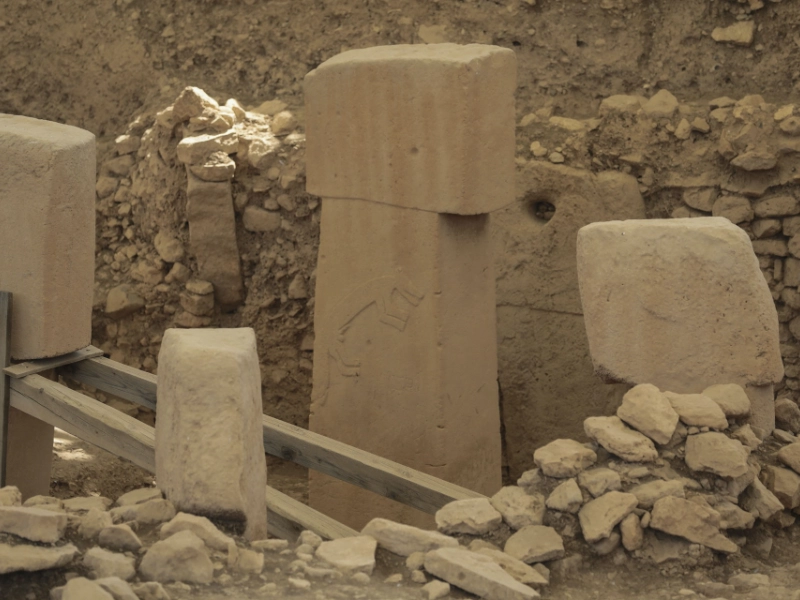
Göbekli Tepe's artistic legacy is among its most fascinating features since it provides a portal to the symbolic and creative universe of our prehistoric forebears. Archaeologists, art historians, and the general public all equally find great study and appreciation for the complex carvings and reliefs discovered at the site, which have transformed our knowledge of early human artistic expression.
The profusion of animal images carved into the T-shaped pillars is the most arresting aspect of Göbekli Tepe's creative heritage. Lions, bulls, boars, foxes, gazelles, snakes, and many species of birds and insects are among the great range of animals these carvings capture. These images have amazing naturalism and detail, implying a skilled artistic heritage and a close knowledge of the local species. While some animals are shown in dynamic positions, catching movement and energy in stone, others are represented with almost perfect realism that betrays their ancient age.
Beyond the animal images, Göbekli Tepe's work features geometric patterns and abstract symbols. Many interpretations of these mysterious designs—which feature circles, wavy lines, and H-shaped symbols—have been generated. While some scientists speculate they might be tied to astronomical observations or shamanic experiences, others say they might reflect early forms of written communication or symbolic systems. These abstract components together with realistic animal representations show a sophisticated visual language combining representational and non-representational forms.
Göbekli Tepe's artistic methods are also really remarkable. Low relief is used in the carvings; some pieces show out more clearly than others, therefore establishing depth and hierarchy within the compositions. The artists showed a great capacity to work with the stone's natural shapes and textures, deftly matching their patterns to the pillar surface. By thousands of years, this advanced approach to relief carving surpasses comparable methods in other ancient societies, therefore questioning our understanding of the evolution of artistic ability in prehistory.
Göbekli Tepe's art is fascinating in part because of its possible narrative quality. Some pillars show scenarios with multiple animals and symbols interacting in intricate compositions that seem to convey stories or capture certain events. These story components have inspired some scholars to hypothesise about the presence of early myths or oral traditions that might have been visualised in stone. Göbekli Tepe's artistic legacy gains still another level of relevance from the idea that these carvings reflect some of the first known visual narrative.
The artistic successes at Göbekli Tepe also beg problems regarding the social structure and specialisation of the communities that produced them. The consistency in style and technique across the site points to the work of talented artists, maybe signifying the development of specific roles within hunter-gatherer societies. This questions accepted wisdom on the degree of social complexity in prehistoric societies and implies that artistic output might have been quite important for social organisation and identity development.
The creative legacy of Göbekli Tepe has impact outside of the site. Other Neolithic sites in the area have revealed similar artistic themes and techniques, implying a broad cultural culture maybe derived from Göbekli Tepe.
Our knowledge of prehistoric art and symbolism has been profoundly changed by this creative legacy. It questions the idea of a straight development in creative sophistication and suggests instead that sophisticated cultural traditions might develop and flourish even in hunter-gatherer civilisations. Göbekli Tepe's art is evidence of early people' creative ability and their potential to give their surrounds significance and beauty.
Inspired by the ancient motifs of Göbekli Tepe, contemporary artists and designers have included aspects of its iconography into their own creations. Museums all around the world now feature replicas or digital reconstructions of Göbekli Tepe's pillars, so enabling visitors to personally experience the amazing artistry of our ancient predecessors. This rebirth of interest in prehistoric art forms shows the continuing power of these ancient symbols to captivate and inspire across millennia. Along with raising public interest in prehistoric art, this exposure has spurred fresh conversations on the universal character of artistic expression and the beginnings of human creativity.
Researching Göbekli Tepe's artwork keeps revealing fresh understanding of archaic society. While new analytical approaches are clarifying the materials and methods employed by the ancient artisans, advanced imaging technologies have exposed hitherto invisible features in the sculptures. Research advances the creative legacy of Göbekli Tepe, which is evidence of the inventiveness, originality, and symbolic intricacy of our prehistoric forebears, therefore transforming our view of early human artistic achievements.