Advertisement
Set out a fascinating trip into the universe of pi (π), a number that has enthralled mathematicians, physicists, and inquisitive brains for millennia. This essay explores the unexpected locations in nature, science, and our daily life where this irrational and transcendental constant shows up. Discover the enchantment of pi and its great impact on our knowledge of the cosmos from the smallest subatomic particles to the huge distances of space.
1. The Basics: What is Pi?
Advertisement
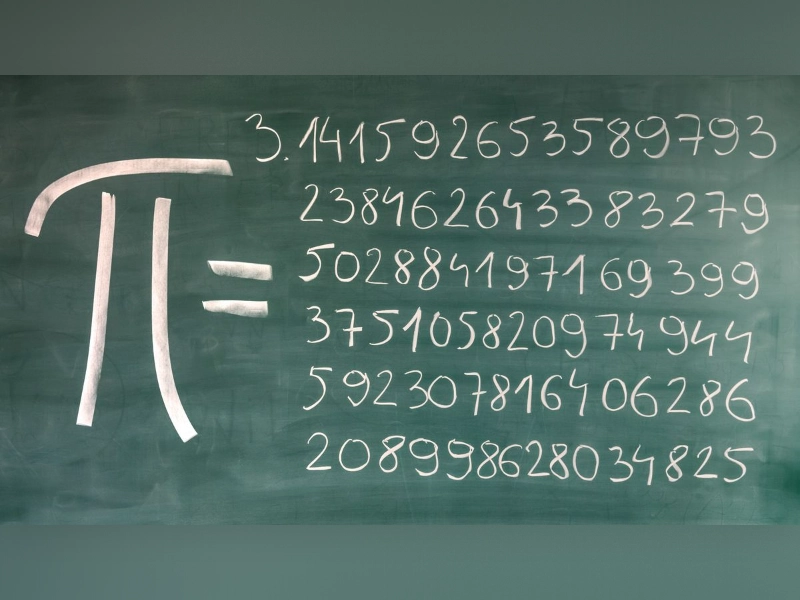
Pi, denoted by the Greek letter π, is a mathematical constant expressing the circle's diameter to its circumference ratio. In mathematics and beyond, this apparently basic idea is quite important. Fundamentally, pi is an irrational number—that is, it cannot be stated as a simple fraction and contains an endless number of decimal points without repeating pattern. For millennia, mathematicians and aficionados have been enthralled with this quality alone, motivating them to compute its digits to amazing degrees.
Pi's path starts in ancient times when early societies realized a circle's diameter and circumference were always in constant association. Early estimates were achieved by the Babylonians and Egyptians; nevertheless, Archimedes, a Greek mathematician, made major progress toward more precisely computing pi. His approach of inscribing and circumscribing polygons around a circle would help to reduce the value of pi, therefore impacting pi computations for millennia to come.
Our knowledge and computation of pi developed along with mathematics. William Jones originally employed the sign π in the 18th century, then popularized by one of the most prolific mathematicians in history, Leonhard Euler. The 20th century computer transformed our capacity to compute pi to hitherto unheard-of decimal places. Pi has been computed as of 2021 to be over 62 trillion digits, a feat that tests storage capacity and processing capability.
Though it is infinite, we usually use an approximative value of pi in daily computation. We commemorate Pi Day on March 14th (3/14 in the month/day format), since most pragmatic uses for the figure 3.14159 call for it. But pi's actual beauty resides in its enigmatic qualities and surprising appearances all around the natural world as much as in its useful applications.
In mathematics, Pi's transcendence and irrationality have great consequences. Its irrationality makes it impossible to articulate as a ratio of two integers; its transcendence suggests that it is not the root of any polyn equation with integer components. These characteristics make pi a special and necessary constant in mathematics, having important functions in many disciplines including geometry and sophisticated analysis.