Advertisement
6. Calculating Pi: From Ancient Methods to Modern Supercomputers
Advertisement
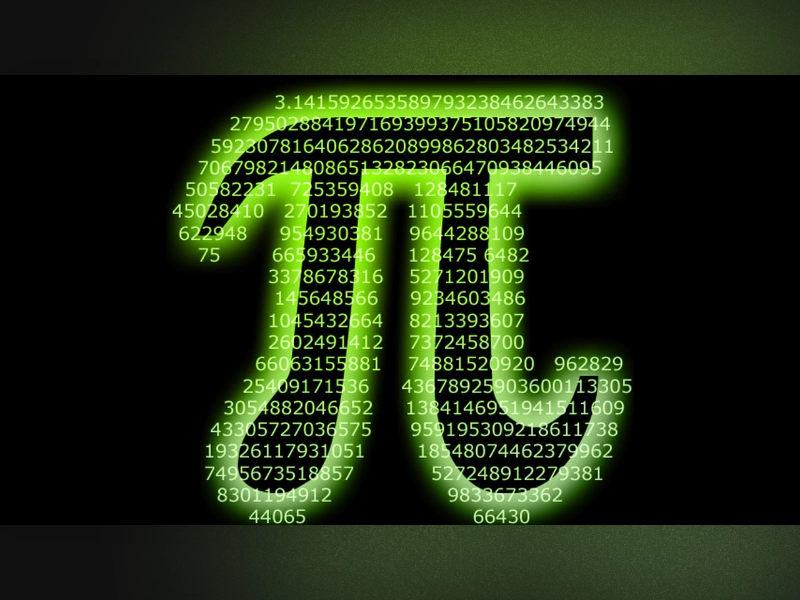
Pi's computation history is an interesting trip reflecting the evolution of mathematics and computational tools. Mathematical and technical innovation has been propelled in both ancient approximations and contemporary supercomputers by the search for additional digits of pi.
Though their estimations were quite primitive, ancient civilizations understood the continuous relation between the diameter and circumference of a circle. In their calculations, the Babylonians employed 3.125; the Egyptians used 3.16. Impressive for the time, the ancient Chinese mathematician Zu Chongzhi computed pi to seven decimal places in the 5th century CE.
With his technique of exhaustion, the Greek mathematician Archimedes made a major discovery in the third century BCE. He proved pi was between 3 10/71 and 3 1/7 by inscribing and circumscribing regular polygons within and around a circle. For millennia, the principal way to estimate pi would still be this approach of approximating circles using polygons.
Mathletes such as Al-Khwarizmi and Al-Kashi advanced even more during the Islamic Golden Age; Al-Kashi computed pi to 16 decimal places in the 15th century. Calculus developed by Newton and Leibniz in the 17th century gave Europe fresh means of pi computation. More effective calculations made possible by infinite series include Machin's formula and the Gregory-Leibniz series enabled for
Calculation of more digits of pi became a race in the 18th and 19th centuries. The record set by the Slovene mathematician Jurij Vega in 1789—pi to 140 decimal places—stood for 52 years. William Shanks calculated pi by hand for years, arriving at 707 digits in 1873; later on, it was found that he had made a mistake following the 527th digit.
Early 20th century mechanical calculators hastened the rate of computation. Among the first electronic computers, ENiAC computed pi to 2,037 digits in 1949. This started the computer age in pi computation, and the count of known digits started to expand exponentially.
The search for extra digits of pi has depended critically on the evolution of more effective algorithms. Calculations were greatly accelerated upon the 1960s discovery of rapid Fourier transform techniques. A major advance over earlier techniques, Eugene Salamin and Richard Brent separately found in 1976 an algorithm that doubled the number of accurate digits with each iteration.
Pi computation has been pushed to new limits by contemporary supercomers. Emma Haruka Iwao computed pi to 31.4 trillion digits using Google Cloud in 2019; this record stood until 2021 when scientists at the University of Applied Sciences of the Grisons computed pi using a supercomputer running for 108 days.
Beyond only pure mathematics, these rigorous computations of pi have useful applications. They enable numerical analytical method testing and act as standards for supercomputer performance. Applications of the developed techniques for these computations extend beyond random number generation and cryptography to other spheres of computer science.
But the search for extra digits of pi begs philosophical problems. Why do we keep pushing for more given that even the most exact scientific calculations require only few digits (40 digits would be enough to determine the diameter of the observable universe to within the width of a hydrogen atom)? The human drive to explore and push limits as well as the technology developments these computations both demand and inspire help to provide the response.