Advertisement
7. The Future of Pi: Ongoing Research and Unsolved Mysteries
Advertisement
Pi will remain a topic of great mathematical study and conjecture as we gaze ahead. Notwithstanding millennia of research, many unresolved issues and continuous fields of inquiry about this amazing number remain.
One of the most interesting fields of study is on the normalcy of pi. A number is said to be normal if its digits are distributed evenly, i.e., if in an infinite decimal expansion every digit—0–9—would show equal frequency. Although pi is clearly normal, this has not been shown mathematically. Should this prove, it would mean that the decimal expansion of pi exhibits any finite sequence of digits with the frequency you would naturally expect. This might affect random number creation and encryption among other domains.
Searching for patterns in pi's digits is another topic of continuous inquiry. Although the billions of computed digits thus far show no repeating pattern, mathematicians nevertheless examine these digits for any latent regularities or patterns. Some scientists hunt for trends that might not be obvious to the unaided eye by means of sophisticated statistical approaches and machine learning algorithms.
Still another area of active study is the relationship between pi and prime numbers. One of the most well-known unresolved mathematical riddles, the Riemann Hypothesis relates to pi by means of the Riemann zeta function and addresses prime number distribution. A demonstration of the Riemann Hypothesis would have great consequences for our knowledge of prime numbers and, hence, for fields such as encryption depending on the features of primes.
Within the subject of quantum computing, pi is involved in several algorithms and quantum error correcting systems. Quantum computers may present fresh approaches to investigate pi and its characteristics as they grow more sophisticated, therefore providing perhaps difficultly obtained insights with conventional computers.
Still under ongoing study is the hunt for mathematical equations capable of effectively producing digits of pi. Although mathematicians are continually searching for more elegant or efficient methods to represent or compute pi, we have several formulas for pi including iterative algorithms and infinite series.
Pi exists in many basic equations in physics; so, continuous study in theoretical physics—especially in fields like string theory and quantum gravity—may expose fresh functions for pi in our knowledge of the cosmos. Deeper knowledge of pi, some physicists argue, might shed light on the basic character of space and time.
Pi's cultural and instructive qualities are likewise changing. Pi provides a convenient starting point for talking about difficult mathematical ideas as mathematical literacy becomes ever more crucial in our technologically advanced society. Using technology to produce interactive visuals and experiences that make abstract mathematical ideas more real, educators and academics are investigating fresh approaches to employ pi as a teaching tool.
Within the field of computer mathematics, the techniques applied to derive digits of pi keep changing. Although we might not need more digits for useful purposes, the search of more effective computation strategies usually results in developments in algorithm design and computational approaches with more general uses.
Still under debate among mathematicians and scientific philosophers are the philosophical ramifications of pi. Our knowledge of pi addresses issues regarding the nature of mathematical truth, the interaction between mathematics and the physical world, and the idea of infinity.
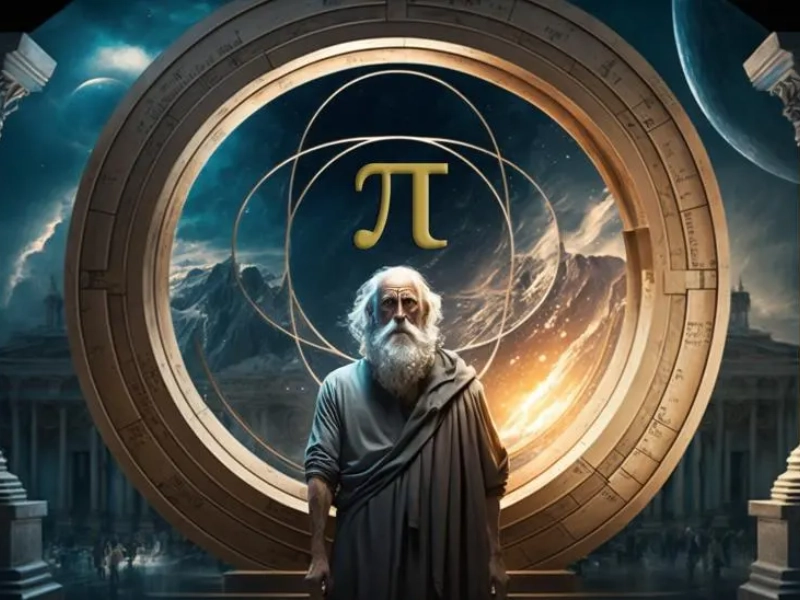
Pi stays a symbol of the beauty and wonder of mathematics going ahead. It is a link between the physical reality we live in and the abstract world of pure mathematics, always motivating next generations of intellectuals to investigate the basic character of numbers, forms, and the cosmos itself. Continually revealing fresh links and insights into the mathematical fabric of our world, pi research promises to be as rich and unexpected as its past.